
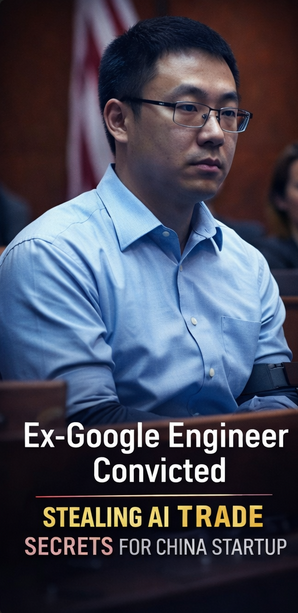
A former Google engineer has been found guilty in the United States after prosecutors said he stole thousands of confidential Google files related to artificial intelligence and high-performance computing.
The U.S. Department of Justice (DOJ) announced Thursday that Linwei Ding (also known as Leon Ding), 38, was convicted by a federal jury on 14 total counts — including seven counts of economic espionage and seven counts of theft of trade secrets.
Authorities say Ding took more than 2,000 internal documents containing sensitive Google trade secrets, allegedly with the intention of using the information to help build an AI-focused business connected to China.
DOJ: AI Innovation Is Now a National Security Issue
U.S. officials framed the case as part of a larger effort to defend America’s technology edge in AI.
Prosecutors emphasized that Silicon Valley plays a major role in AI leadership and warned that foreign efforts to gain access to U.S. intellectual property can harm both economic competitiveness and national security.
What Was Allegedly Stolen
According to court records and DOJ statements, the stolen documents included highly sensitive details connected to Google’s AI infrastructure — the kind of systems required to train and run powerful AI models at scale.
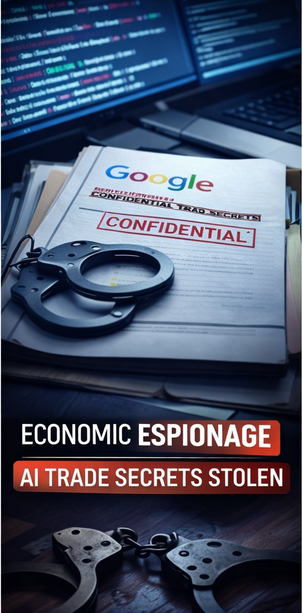
The trade secret material reportedly involved areas such as:
- Google’s custom Tensor Processing Unit (TPU) architecture and systems
- GPU-based AI infrastructure
- software used for chip communication and task execution
- internal systems that coordinate thousands of chips into a “supercomputer-like” AI environment
- a custom-built SmartNIC network card, used for high-speed data movement inside AI supercomputing and cloud networks
In simple terms: this was not normal engineering paperwork — it was core infrastructure design and operational tooling that supports large-scale AI development.
Timeline of the Theft
Investigators said the theft took place between May 2022 and April 2023.
Ding joined Google in 2019, but prosecutors claim he began working toward business opportunities tied to China while still employed at Google.
By mid-2022, he was reportedly in discussions to take on a leadership role (CTO) at a China-based tech firm. Later, he allegedly moved toward founding his own AI company, which prosecutors identified as Shanghai Zhisuan Technologies Co., formed in 2023.
Officials also stated that Ding downloaded documents again in December 2023, less than two weeks before he resigned from Google.
Prosecutors Say He Tried to Cover His Tracks
The DOJ claims Ding took deliberate steps to hide what he was doing.
One of the most notable allegations: instead of simply copying files directly, he reportedly moved information into Apple Notes, converted the notes into PDFs, and then uploaded them into a personal Google Cloud account.
Prosecutors also accused him of asking another Google employee to use Ding’s company badge to enter a Google facility — creating the impression he was physically working in the office, when authorities say he was actually in China.
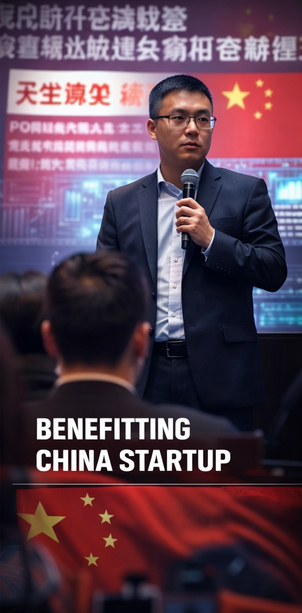
The case reportedly started falling apart when Google learned Ding had delivered a public presentation in China to potential investors, where he discussed his startup plans.
Economic Espionage Charge Added in 2025
In February 2025, Ding was hit with additional economic espionage charges. Prosecutors said a superseding indictment also pointed to Ding applying to a China-based “talent” program.
These programs have been criticized by U.S. authorities in past cases, with claims that they encourage overseas researchers and engineers to bring their skills and innovations back to China to accelerate national technological development.
The DOJ said evidence presented during trial suggested Ding intended to help China-linked entities through work connected to:
- AI supercomputer development
- research into custom machine learning chips
What Happens Next
Ding is scheduled to appear at a status conference on February 3, 2026.
If sentenced to the maximum, he faces:
- up to 10 years per trade secret theft count
- up to 15 years per economic espionage count
This case is one of the most prominent examples yet of how AI innovation is now directly tied to economic espionage concerns, and why governments are treating AI infrastructure secrets like strategic assets.