
AI agents are changing how work gets done inside companies. They can schedule meetings, pull data, run workflows, write code, and take actions automatically. In many cases, they move faster than people ever could, and that speed is boosting productivity across the enterprise.
But sooner or later, every security team runs into the same problem:
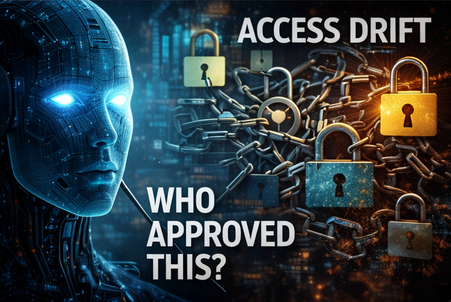
“Who approved this agent… and what exactly can it do?”
AI agents don’t behave like normal users or traditional applications. They are often rolled out quickly, reused across teams, and given wide access so they can “be helpful.” That makes it difficult to track ownership, approvals, and accountability. A question that used to be simple in IAM now becomes hard to answer.
Why AI Agents Break Traditional Access and IAM Models
AI agents aren’t just another account type. They introduce a new access model that existing security frameworks weren’t designed for.
How access usually works today
- Human users
Access is tied to a job role, reviewed periodically, and limited by intent, time, and context. - Service accounts
These are non-human accounts, but they are usually created for a specific app task, with limited permissions and predictable behavior.
What makes agents different
AI agents operate using delegated authority. Once approved, they can act with independence and run continuously. They can also function across multiple systems and data sources to complete tasks end-to-end.
That changes the security model in a major way:
Instead of automating a person’s actions, agents often expand what actions are possible.
To be effective, many agents are granted broad permissions. In some cases, the agent can perform actions that the requesting employee could not legally do on their own. The action is technically permitted because the agent has valid credentials, but the result may violate intent, policy, or authorization boundaries.
That’s how you get access drift:
- Agents get more integrations over time
- Teams change
- Workflows expand
- Old permissions are never removed
Eventually, the agent becomes a long-lived, high-power identity with no clear owner and no real governance.
Traditional IAM expects:
✅ clear identity
✅ stable roles
✅ defined ownership
✅ periodic reviews
AI agents don’t fit those assumptions. Their real risk depends on how they’re used, not how they were approved on day one.
The 3 Major Types of AI Agents in Enterprise Environments
Not all agents carry the same risk. In practice, they fall into three categories:
1) Personal AI Agents (employee-owned)
These are assistants tied to one employee. They help with daily tasks like:
- drafting content
- summarizing documents
- scheduling meetings
- helping write code
They typically inherit the user’s permissions. If the user loses access, the agent loses access too.
✅ Ownership is clear
✅ Scope is limited
✅ Blast radius is small
This makes them the easiest to govern.
2) Third-Party AI Agents (vendor-owned)
These agents are built into platforms like SaaS products, collaboration tools, CRMs, and security solutions. The vendor owns and maintains them.
The biggest risk here is supply-chain trust:
- How does the vendor secure the agent?
- What controls and guarantees exist?
- How transparent is the design?
Even if visibility is limited, accountability is generally clear because the vendor owns the agent.
3) Organizational AI Agents (shared, often ownerless)
This is where the real security concern is.
These agents are built internally and shared across multiple teams and workflows. They connect systems, automate processes, and often act on behalf of many users.
To function properly, they are usually given:
- broad access
- persistent credentials
- permissions that exceed any individual user
The problem is that these agents often have:
❌ no clear owner
❌ no lifecycle management
❌ no single approver
❌ weak visibility into what they can do
When something breaks, it’s unclear who is responsible or how far the damage spreads.
This category has the highest blast radius, not necessarily because the agent is malicious, but because it’s powerful and unmanaged.
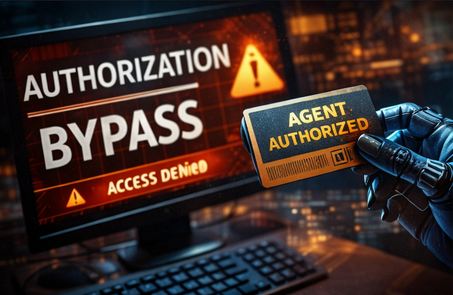
The “Agentic Authorization Bypass” Problem
One of the most dangerous shifts is how agents act as access intermediaries.
Instead of a user directly interacting with systems, the AI agent becomes the middleman:
user → agent → system
That sounds harmless until you realize what it enables.
A user might not be allowed to:
- access restricted data
- run certain workflows
- trigger privileged actions
But if the agent can do those things, the user only needs to ask the agent.
From the system’s point of view, everything looks legitimate because the agent’s tokens and credentials are valid. Traditional controls don’t flag the behavior because no “unauthorized login” happened.
That is the essence of an agent-driven authorization bypass:
✔ technically authorized
✖ contextually unsafe
✖ outside normal approval models
What Enterprises Must Change to Secure AI Agents
To secure AI agents properly, companies need to treat them as their own risk class, not as “tools” or extensions of employees.
Key changes include:
1) Ownership must be mandatory
Every agent should have:
- an owner
- a purpose statement
- a defined scope
- review requirements
No owner = no accountability.
2) Map who can invoke each agent
Security teams can’t only track what the agent can access. They also need visibility into:
- which users can call the agent
- when and how it can be triggered
- what effective permissions are being used during execution
Without that connection, agents become invisible privilege escalators.
3) Map the full access path across systems
Real risk can only be understood through full correlation:
user → agent → system → action → data
That’s how organizations can:
- calculate blast radius
- detect misuse
- investigate incidents properly
- reduce privilege creep
The Real Cost of Uncontrolled Organizational Agents
The biggest danger isn’t that organizational agents are intentionally harmful. It’s that they run at scale, over long periods, with high permissions, and often without strong governance.
Over time:
- their scope expands
- their access grows
- logging becomes messy
- ownership disappears
So when an incident happens, response becomes chaotic because nobody can confidently answer:
- What does the agent have access to?
- Who can trigger it?
- What did it do last week?
- Which system is impacted?
Without visibility and control, organizational AI agents can become one of the least governed and highest-risk identities in modern enterprise environments.